
Registration is mandatory for NDIA-managed plans and for high-risk supports, including SIL, SDA, and specialist behaviour support.
| Key Detail | Info |
|---|---|
| Registered by | NDIS Quality and Safeguards Commission |
| Alpha Community Care NDIS ID | 4050094311 |
| Service locations | Melbourne (Docklands, VIC) and Perth (West Perth, WA) |
| Registration mandatory for | NDIA-managed plans, SIL, SDA, Forensic Disability, Complex Nursing |
Unregistered providers can still deliver NDIS supports legally. They just haven’t gone through that process.
The NDIS Quality and Safeguards Commission doesn’t just approve providers and walk away. It holds them accountable ongoing. That means providers have to follow Practice Standards, detailed rules around how services are delivered, including documented complaint processes and 24-hour incident reporting. They have to uphold the Code of Conduct, which covers how workers treat you day to day: respecting your choices, protecting your privacy, and acting with integrity. And independent auditors regularly show up, review files, interview staff, and make sure what’s happening on the ground actually matches what’s on paper.
Think of it as a health inspection system for disability services, except the stakes are considerably higher than a restaurant getting a hygiene rating.
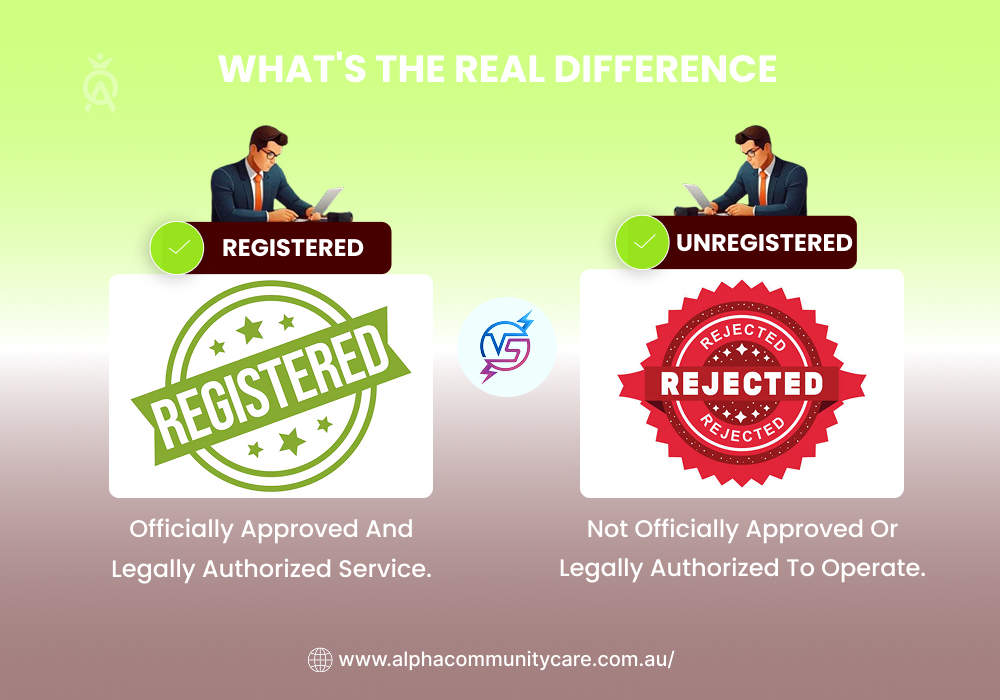
For self-managed and plan-managed participants, unregistered providers are a legitimate option for lower-risk supports like community access, social participation, household help, transport, and skills development. And here’s something worth saying clearly: unregistered doesn’t mean bad. Plenty of excellent small providers don’t register because the audit costs are genuinely burdensome for a small team. The difference is that without registration, nobody external is checking their work. You’re the oversight.
Registered vs Unregistered at a Glance
| Registered | Unregistered |
| ✅ Regular safety audits | ❌ No formal NDIS audits |
| ✅ Verified worker screening | ⚠️ Variable screening |
| ✅ Commission complaint pathway | ❌ Internal process only |
| ✅ Must report serious incidents | ⚠️ Report to you only |
| ❌ Sometimes less flexible | ✅ Often more flexible |
| ❌ Possible longer waitlists | ✅ Usually faster access |
Registered means stronger, independently verified safeguards. Unregistered means potentially more flexibility and fewer formal protections when things go sideways.
How Registered Providers Are Kept Accountable
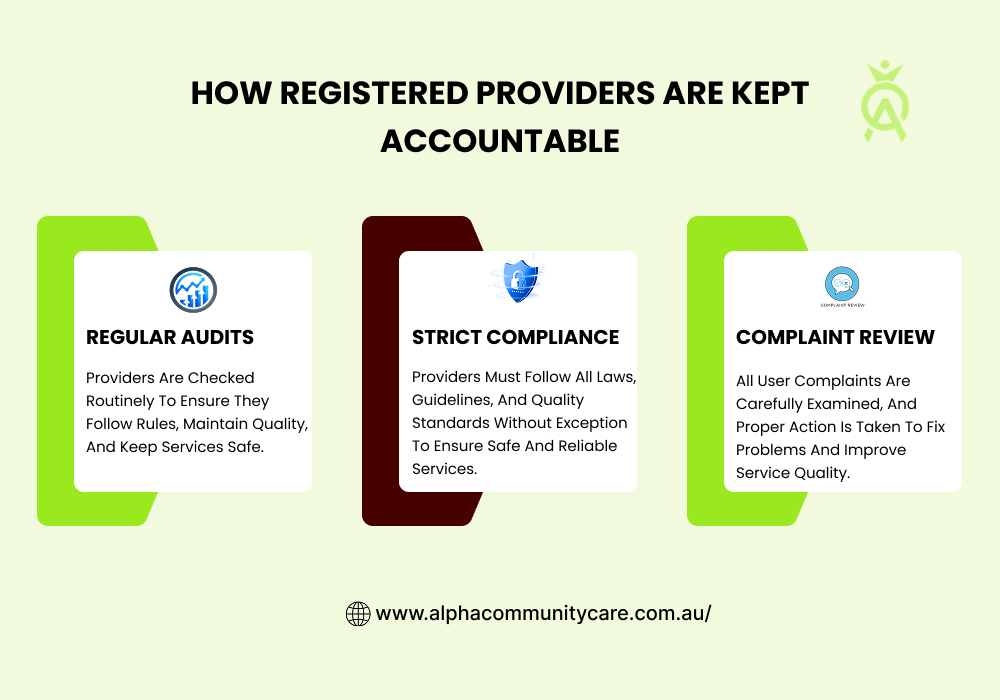
Every registered NDIS provider has to make sure all staff hold a current NDIS Worker Screening Check, a more thorough assessment than a standard police check, specifically designed to flag histories of harm or misconduct. They need documented procedures for managing accidents, injuries, and abuse allegations, and those procedures have to kick in within 24 hours. There has to be a formal complaints pathway where you get a written response; a phone chat doesn’t cut it. And independent auditors check in regularly to confirm providers are genuinely following their policies, not just keeping them in a folder.
When something goes wrong
You’ve always got two pathways. Start with the provider’s own process: talk to your coordinator directly, put your complaint in writing, and ask for a clear timeline for resolution. If that doesn’t get you anywhere, take it to the NDIS Commission, call 1800 035 544 or visit ndiscommission.gov.au.
Registered NDIS providers also have a legal obligation to report certain incidents to the Commission within 24 hours: death or serious injury, abuse or neglect allegations, unauthorised restrictive practices, and sexual misconduct. The Commission investigates and can penalise or deregister providers who don’t hold up their end.
How to Check If a Provider Is a Registered NDIS Provider
Registration isn’t a certificate you frame and forget. It comes with ongoing obligations that directly affect your safety.
Every registered NDIS provider has to make sure all staff hold a current NDIS Worker Screening Check, a more thorough assessment than a standard police check, specifically designed to flag histories of harm or misconduct. They need documented procedures for managing accidents, injuries, and abuse allegations, and those procedures have to kick in within 24 hours. There has to be a formal complaints pathway where you get a written response; a phone chat doesn’t cut it. And independent auditors check in regularly to confirm providers are genuinely following their policies, not just keeping them in a folder
When Things Go Wrong
You’ve always got two pathways. Start with the provider’s own process: talk to your coordinator directly, put your complaint in writing, and ask for a clear timeline for resolution. If that doesn’t get you anywhere, take it to the NDIS Commission, call 1800 035 544 or visit ndiscommission.gov.au.
Registered NDIS providers also have a legal obligation to report certain incidents to the Commission within 24 hours: death or serious injury, abuse or neglect allegations, unauthorised restrictive practices, and sexual misconduct. The Commission investigates and can penalise or deregister providers who don’t hold up their end.
Registered vs Unregistered: When to Choose Which
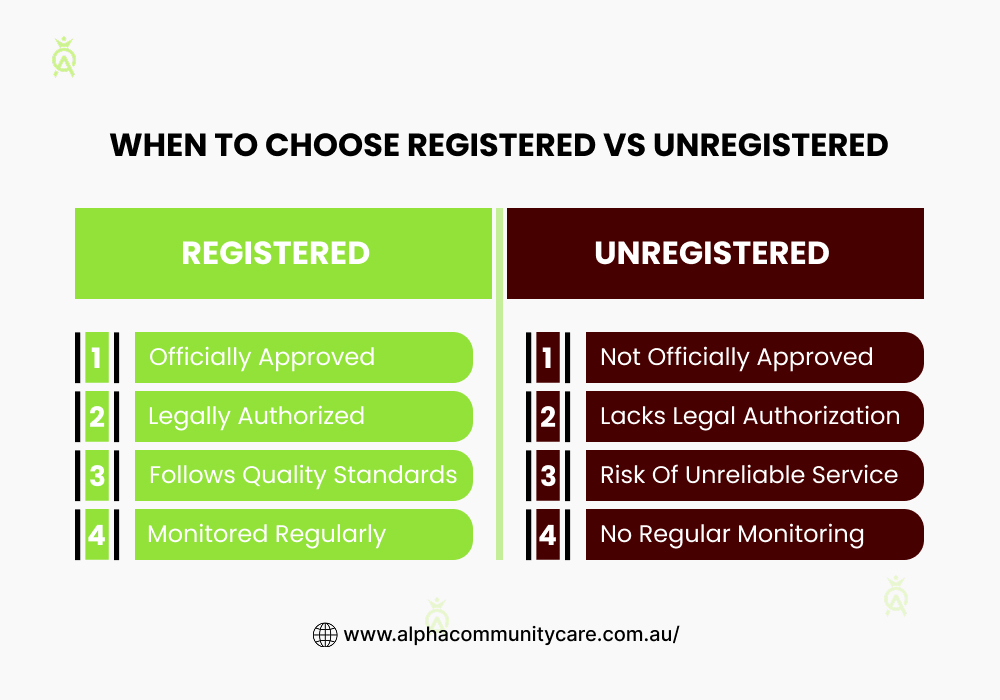
Go With a Registered NDIS Provider When:
If you’re NDIA-managed, it’s mandatory; there’s no decision to make. For everyone else, a registered NDIS provider is the right call for high-risk supports like SIL, SDA, behaviour support, or complex nursing, and for anything involving intimate personal care or overnight assistance. It’s also the safer choice any time you’re working with a provider you haven’t had a chance to assess yet.
Location matters more than most people factor in. A registered NDIS provider with a physical office in Docklands or West Perth can respond to an emergency within the hour. One coordinating from interstate? You might be waiting all day. That gap matters.
Unregistered Can Be the Right Call When:
If you’re self-managed and your supports are low-risk, gym sessions, social outings, help around the house, an unregistered provider can work perfectly well, especially if you know and trust the worker personally. In some rural areas, it may also be the only realistic option. Just keep in mind that unregistered workers still have to follow the NDIS Code of Conduct, even without external monitoring.
The Hybrid Approach
Plenty of participants use both. A registered NDIS provider for nursing, behaviour support, and SIL, where the stakes are high, and you want proper oversight. An unregistered provider for flexible, lower-stakes everyday supports. That’s not a compromise. That’s just smart planning.
Real-World Examples
Forensic disability services
Forensic disability is one of the most underserved areas in the NDIS. It covers participants who’ve had contact with the justice system or need intensive behavioural management, and the complexity involved means a registered NDIS provider isn’t just the better option, it’s the only one the NDIA will fund. Unverified safety systems don’t fly here.
Providers in this space need registered psychologists and behaviour support practitioners, Commission-approved restrictive practices, around-the-clock incident reporting, and active coordination with state corrective services. Alpha Community Care runs dedicated forensic teams in both Melbourne and Perth for exactly this reason: it brings in people who know the local justice system and can move quickly when something changes.
Supported Independent Living (SIL)
Since 2026, every SIL provider has to be a registered NDIS provider, no exceptions. What registration means in this context: verified staff-to-participant ratios, 24/7 clinical supervision, documented emergency response protocols, and enforceable protections for participant rights. Not optional extras. Baseline requirements.
For SIL, your provider’s proximity isn’t just a convenience, it’s a safeguard. A locally based registered NDIS provider can have someone at your door within the hour. Interstate coordination can mean a full day’s wait. At 11 pm, when something’s gone wrong, that difference is everything.
Red Flags When You’re Choosing a Registered NDIS Provider
Warning signs are easiest to miss when you’re already stressed. Watch out for providers who rush you to sign before you’ve had a proper chance to read the contract, or who can’t explain your rights clearly. A provider who genuinely cares about your outcomes will ask about your goals in the first conversation. One who skips straight to their service list is showing you something about their priorities.
Other things to watch for: vague or shifting pricing, unexplained cancellation clauses, no written complaints information, and an inability to provide a registration number on the spot. Be especially wary of providers who claim to be a registered NDIS provider but don’t show up on the NDIS Provider Finder; that’s a serious red flag. The same goes for anyone operating purely through a 1300 number with no local office. And if they can’t name the nearest hospital or community services in your area, they don’t know your community.
Trust your gut. If something feels off, it probably is. Ask more questions, or walk away.
What a Good Registered NDIS Provider Actually Looks Like
Good registered providers should:
- Ask about YOUR goals first
- Involve you in every decision
- Respond to calls/emails within 1-2 days
- Send consistent workers
- Provide transparent invoices
- Ask for regular feedback and act on it
- Respect your schedule
- Document progress for plan reviews
- Have local presence, not just interstate coordination
Questions to Ask Before You Sign Anything
The best questions are the straightforward ones. Ask how they’ll involve you in your own support planning, and whether you can meet workers before anything’s agreed. Ask what the complaints process looks like at every step, and exactly how you’d escalate to the NDIS Commission if needed. Find out how they match participants with workers — and what happens when it’s not working. Ask for a sample invoice. Get cancellation terms in writing.
If you can, bring a family member, friend, or support coordinator to that first meeting. A second pair of eyes catches things that stress and information overload make it easy to miss.
Why Location Matters
Registration is national. Support quality isn’t.
In Melbourne, your registered NDIS provider should have a physical office, not a mailing address, along with genuine knowledge of the Victorian health system, Melbourne’s transport network, and real relationships with local allied health services. In Perth, the bar is the same: a WA-based office, regional capability, solid WA Health system knowledge, and demonstrated cultural competency, particularly for Aboriginal and Torres Strait Islander participants.
The thing to be cautious of is the large “national” provider with a 1300 number, days-long response times, rotating workers who’ve never heard of your suburb, and vague answers when you ask about local resources. A registration number doesn’t come with local knowledge. You have to check for that separately.
Frequently Asked Questions (FAQ)
How do I verify registration?
Search the NDIS Provider Finder at ndis.gov.au. Enter provider name or number (e.g., Alpha Community Care: 4050094311).
Can I switch providers?
Yes, anytime. Check service agreement notice periods (usually 14 days), notify in writing, and coordinate a new start date to avoid gaps.
Do registered providers cost more?
They can charge up to the NDIS Price Guide caps. Unregistered sometimes charge less (no audit costs), but can also charge more if you agree.
What if there are no registered providers nearby?
You may get “thin markets” funding loadings. Talk to your LAC about remote options or NDIA approval for unregistered providers as exceptions
Can providers lose registration?
Yes. The Commission can suspend or cancel registration for serious breaches. You’ll be notified—switch immediately as NDIA won’t pay deregistered providers.
If You’re Unhappy With Your Registered NDIS Provider
Start by raising it directly. Be specific about the problem, ask for a clear resolution timeline, and follow up in writing so there’s a record. If the internal process doesn’t get you a satisfactory outcome, lodge a formal complaint through their official channel. If that still doesn’t move things, escalate to the NDIS Commission: call 1800 035 544 or visit ndiscommission. Your support coordinator, LAC, or a disability advocacy service (1800 818 338) can help you through any part of this.
Switching Providers Without Losing Your Supports
Your Next Steps
Start by verifying your current providers on the NDIS Provider Finder, just to confirm they’re still registered and active. Then check your plan type. NDIA-managed participants need registered NDIS providers across the board. Self-managed and plan-managed participants have more room to move, depending on the risk level of each support.
If you’re in Melbourne or Perth and you need complex support, go with providers who have real local offices. Use the questions in this guide before you sign anything. And remember: you have every right to change providers, raise complaints, and expect support that is actually designed around your life, not around a provider’s roster.
The NDIS Provider Finder is where to start. Filter by location and support type, and look for registered NDIS providers with genuine local knowledge and a physical presence in your area.
For more information, visit Alpha Community Care or reach out to our teams in Melbourne or Perth.