
Navigating the Maze of NDIS Housing
When you or a loved one is in a period of transition, the NDIS housing landscape can feel like a maze of acronyms. Among the most common and most vital are Short Term Accommodation (STA) and Medium Term Accommodation (MTA). While they may sound similar, they serve very different purposes in a participant’s journey toward independence. At Alpha Community Care, we specialize in providing both, and understanding the nuances between them is the first step toward ensuring a participant isn’t just “housed,” but is truly supported.
What is Short Term Accommodation (STA)?
Short-term accommodation, which often includes what was traditionally called “Respite,” is designed for brief stays away from a participant’s usual home. Under the NDIS, STA funding typically covers up to 28 days per year.
The Intent of STA:
- Carer Respite: Giving primary caregivers a necessary break to prevent burnout.
- Skill Building: Allowing the participant to try new things and develop independence in a new environment.
- Emergency Stays: Providing a haven if a usual care arrangement suddenly falls through.
In an Alpha Community Care STA property, the funding is “all-inclusive,” covering 24-hour support, all meals, and negotiated activities. It’s about more than a bed; it’s about a positive, community-based experience.
How STA Works
Duration: 28 days per NDIS plan year. Most people use it in blocks of 14 days at a time, but you can split it however works for you.
What’s included: Everything. 24/7 disability support staff, all your meals (dietary requirements covered), accommodation and utilities, planned activities and community outings, and personal care assistance. You don’t pay extra for any of it.
Who Qualifies for STA
It needs to be approved in your NDIS plan, usually under Capacity Building or a dedicated STA line item. You’ll need documented reasons—either caregiver respite or goals around building independence.
What is Medium Term Accommodation (MTA)?
Medium Term Accommodation is a different beast entirely. It is a bridge. MTA is typically funded for up to 90 days and is used when a participant has a long-term housing solution confirmed, but it isn’t ready for them to move into yet.
The Intent of MTA:
- Hospital Discharge: Bridging the gap for participants who are medically fit for discharge but waiting for home modifications.
- Waiting for SDA: Providing a home while a specialist Disability Accommodation (SDA) build is being completed.
- Crisis Avoidance: Keeping a participant out of aged care or inappropriate settings while their permanent home is finalized.
Unlike STA, MTA funding only covers the “bricks and mortar” (the rent). The personal care support at an MTA property is usually funded separately through the participant’s “Core Supports” budget.
How MTA Works
Duration: Up to 90 days, taken as one continuous stay.
What’s covered: Rent and accommodation costs. Sometimes basic utilities. That’s it.
What’s NOT covered: This trips people up constantly. Personal care and disability support come from your Core Supports budget, not MTA. Meals aren’t covered. Activities aren’t covered. Support workers aren’t covered. If you don’t budget for this separately, you’ll run out of funding halfway through your stay.
MTA Eligibility (This Part is Critical)
You must have confirmed permanent housing already arranged. Not “looking for housing.” Not “hoping to find something.” Confirmed.
That means: a signed lease with a move-in date, or a confirmed SDA placement with documented availability, or home modification approval with a completion timeline.MTA is not for: housing searches, indefinite stays without a permanent plan, or anything beyond 90 days without exceptional circumstances.
STA vs MTA: The Real Differences
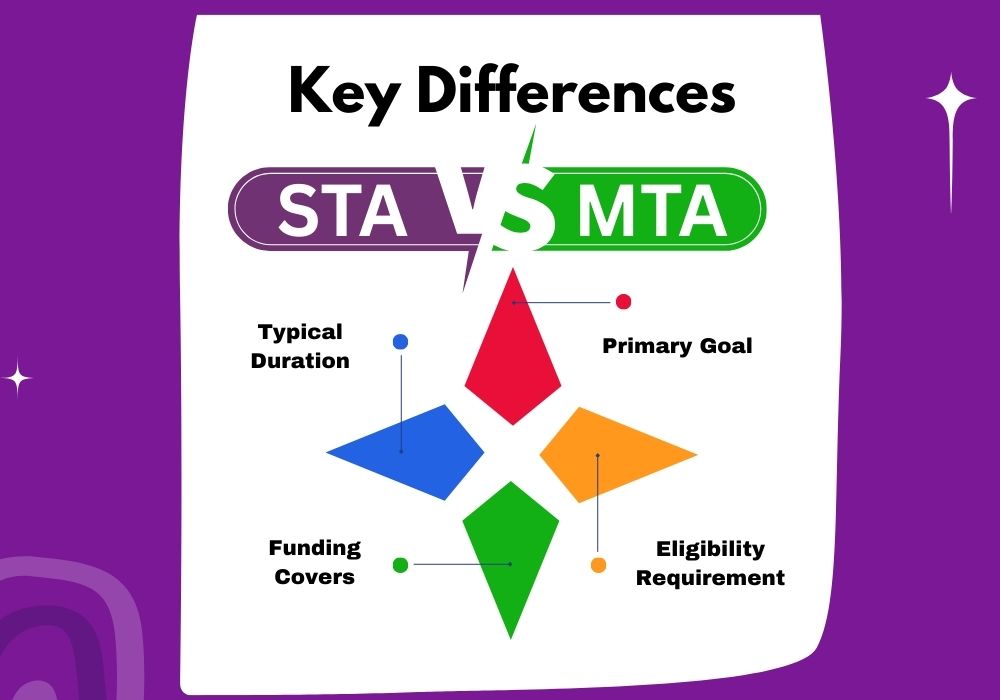
To help you decide which path to take, consider this comparison:
| Feature | Short Term Accommodation (STA) | Medium Term Accommodation (MTA) |
|---|---|---|
| Typical Duration | Up to 14 days at a time (28 total/year) | Up to 90 days |
| Primary Goal | Respite and skill building | Transitional bridge to permanent home |
| Funding Covers | Rent + Food + Activities + 24/7 Support | Rent/Accommodation only |
| Eligibility Requirement | Included in plan for respite/independence | Must have a confirmed long-term home |
Why Your Choice Matters for Long-Term Outcomes
Choosing the wrong type of accommodation can lead to “funding exhaustion.” If a participant uses STA funding for a transition that actually requires MTA, they may run out of respite days when they actually need them later in the year. As a registered NDIS provider in Victoria and Western Australia, Alpha Community Care works closely with Support Coordinators to ensure the right line items are used. We believe that housing is a human right, and the correct housing is the foundation of a successful NDIS plan.
Three Expensive Mistakes That Waste Your NDIS Accommodation Funding
Mistake #1: Burning Through Your Respite Days When You Actually Need MTA
Here’s what happens way too often: You need somewhere to stay for two months while waiting for your permanent place. Nobody tells you MTA exists, so you use up all 28 days of your STA thinking that’s your only choice.
Three months later, your main carer is absolutely exhausted and needs a break. You go to book respite, and there’s nothing left. You’ve used it all up. Now you’re watching your career head straight toward burnout, and you’ve got no backup plan.
Here’s the thing: If you’ve already got permanent housing sorted and you need more than a month somewhere temporary, that’s literally what MTA is for. Don’t let anyone tell you to use up your respite days. Save those for when you actually need a break.
Mistake #2: Asking for MTA While You’re Still House-Hunting
This gets people rejected instantly. They think MTA will buy them time to find somewhere permanent. They apply. The answer’s always no.
Why? Because MTA isn’t there to help you look for housing. It’s a bridge between where you are now and a place you’ve already got locked in. The NDIA wants proof, a signed lease, a confirmed spot in SDA, and paperwork showing your home mods will be done by a certain date. No proof? No MTA.
Do this instead: Sort out your permanent housing first. Get everything signed and confirmed. Then ask for MTA to cover the waiting period. Not before.
Mistake #3: Not Realising MTA Only Pays Your Rent
This one doesn’t bite you until you’ve already moved in.
You got MTA approved. Great. You moved in. Then you figure out support workers aren’t covered. Meals aren’t covered. Your personal care is coming out of a different budget, and suddenly, you’re running out of money way faster than you thought. You’re stuck there for another two months with no funding left for the support you need.
Do this first: Before you say yes to MTA, sit with your Support Coordinator and work out every single cost for the whole 90 days. Support, personal care, food, getting around—everything. Make sure your Core Supports budget can actually cover it. Find out now, not after you’re already living there.
Alpha Community Care in Victoria and Western Australia
Where We Are
We’ve got Short Term Accommodation and Medium Term Accommodation properties in Melbourne (including regional Victoria) and Perth. We picked these locations because staying near your regular doctor, specialists, and community matters when you’re in transition.
Why We’re Different
You know that feeling when you walk into most disability places and immediately know you’re in a facility? Plastic furniture. Hospital vibes. Staff who barely know your name.
We built our places to actually feel like homes. Support workers who know your morning coffee routine matters. Who gets that missing your physio appointment messes up your whole week? Who understand keeping up with your community during a stay isn’t extra, it’s basic.
Just warehousing people for a few weeks? That’s not our thing.
Our STA Setup
Our 24/7 support comes from people who’ve been doing disability work for years, not someone fresh out of training, reading from a manual. Skill-building means we work on what you want to learn, not some one-size-fits-all program.
Activities match what you’re into. Sports person? We’re not forcing you into craft sessions. Want to learn to cook? You’re not stuck watching movies every night. Emergency placement needed right now? We’ll work with whatever space we’ve got instead of telling you to wait six weeks.
Our MTA Setup
Being in temporary housing can feel really unstable. Doesn’t have to be that way.
We talk directly to your existing support providers, so nothing changes with your personal care. Same routine, same level of help, no mess-ups. We get you to your medical appointments and help you stay connected locally instead of feeling stuck in limbo for three months.
When you’re ready to move to your permanent place, we coordinate with your Support Coordinator so the handover is smooth. No gaps where nobody knows who’s doing what.
How to Actually Get STA or MTA
Getting STA
Step 1: Bring it up at your NDIS planning meeting. Don’t wait for them to mention it; lots of people don’t even know they can ask.
Step 2: Tell them exactly why you need it. Carer needs a break? You want to build skills? Need emergency backup? Be specific.
Step 3: Make sure it’s actually written into your plan. Check the paperwork.
Step 4: Find a registered STA provider. We’re registered in Victoria and WA, but pick whoever works for you.
Step 5: Book however makes sense, one long stay, a few short breaks, or save it for emergencies.
Timing: Try to book 2-4 weeks ahead if you can. Emergencies? We’ll fit you in if we’ve got space. Sometimes same-week works the same week.
Getting MTA
Step 1: Get your permanent housing sorted first. Not “thinking about it”, actually done. Signed lease, confirmed SDA spot, home mods approved with a finish date. Get the paperwork.
Step 2: Ask for MTA through a plan review. You’ll need to explain why you need it and prove your permanent place is confirmed.
Step 3: Hand over all your housing paperwork. No confirmed housing = automatic rejection.
Step 4: Check your Core Supports budget covers everything for the full 90 days. MTA only pays rent. Everything else is on you. Do the math first.
Step 5: Contact an MTA provider once it’s approved.
Timing: Usually 1-2 weeks from approval to moving in. Complex needs or want a specific location? Call earlier. We need time to coordinate with your support providers.
Questions People Actually Ask
Can I use both STA and MTA in one year?
Yes. They’re completely separate funding lines for different purposes. Using MTA doesn’t touch your 28 STA days. You could theoretically use both in the same month if you needed respite before moving into transitional accommodation.
What if I run out of STA days before my plan renews?
You’re stuck until renewal unless you request a plan review and can justify why you need more. This is exactly why choosing the right accommodation type from the start matters so much. If you burn STA days on what should be MTA, you lose your safety net.
Does MTA pay for support workers and food?
No. Just rent.
Support workers, personal care, meals, activities, getting around, all of that comes out of your Core Supports budget. Most people don’t realize this until they’ve already moved in and the money’s running out
Do I need housing confirmed before applying for MTA?
Yes. You must have it locked in first.
They want proof: signed lease, confirmed SDA spot, or approved home modifications with a completion date. No confirmed housing = instant rejection. Every time.
How much notice for STA or MTA bookings?
STA: 2-4 weeks for planned stays. Emergencies? Sometimes same week if there’s space.
MTA: 1-2 weeks usually. Complex needs? Call earlier so they can coordinate everything properly.
Taking the Next Step
Understanding STA versus MTA really comes down to timing and purpose. STA is for breaks and skill-building. No permanent housing needed. MTA is different; it only works when you’ve already got permanent housing locked in, but you’re waiting for it to be ready.
Not sure which one applies to your situation? You’re not alone. If you’re a coordinator trying to find something available right now in Victoria or WA, we get it. That’s what we’re here for.
Ready to Check What’s Available?
Contact Alpha Community Care. Our intake specialists will actually look at your plan, not just skim it, and help you figure out what fits your goals and timeline. Need respite? We’ll talk STA. Waiting for your permanent place? We’ll sort out MTA.
Let us help you find the right option. Not just any accommodation. The one that actually makes sense for where you are right now and where you’re headed.
Call our intake team or shoot us an email with your plan details. We’ll get back to you within 24 hours.


A really good blog and me back again.